← Back to blog index · 2026-05-10
Bitfinex Funding Period Selection — 2/7/30/120 Days Analyzed With Real 2026 Data
Complete trade-off analysis for the 4 Bitfinex Funding period buckets. Real APR distributions from 2026, prepayment risk, when to pick which. Boxplot + decision matrix included.
Bitfinex Funding lets you choose lending periods from 2 to 120 days. Most people default to 2 days because “shorter feels safer”.
That’s usually wrong. Locking longer typically earns more — you just need to know when to lock long and when to stay short. This post explains the trade-offs with real 2026 data.
TL;DR
- Short (2d): lower APR (median 3-6%), best for capturing spikes and rotating fast
- Mid (7d): balanced default (median 5-7%), most-used preset
- Long (30d): higher APR (median 7-10%), but exposure to prepayment shortening
- Xlong (120d): highest nominal APR (median 8-13%, spike-mode 25%+), highest prepayment risk
- Multi-bucket diversification typically beats single-period by 1-3pp APY
The 4 Buckets — Real APR Distributions
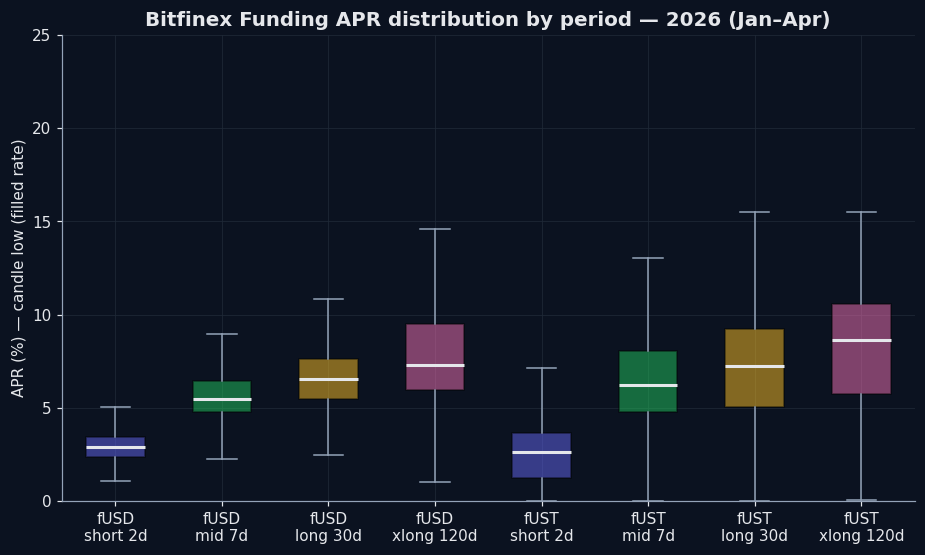
Box plot below uses Bitfinex 2026 Q1 public candle data. Each box shows the 25-75 percentile range of “candle low” (= filled rates) per bucket.
Key observations:
- fUSD systematically pays more than fUST by 1-2pp on average (USDT is the dominant collateral)
- APR scales with period as theory predicts, but fUST long periods (30d/120d) have higher dispersion
- 120d xlong upper tail is extreme, but the median isn’t far above 30d — most of the time the gap is small
Why Longer Periods Pay More
It’s a borrower premium:
- Borrower locks 2 days → if rates rise, they renegotiate quickly. Low risk → low premium.
- Borrower locks 120 days → stuck for 4 months. If rates spike to 50% during that window, they still pay 13%. They want compensation upfront.
Empirical: Bitfinex’s public funding data shows 2026 fUSD 120d averaging 4-7pp above 2d.
Real Use Cases for Each Period
Short 2d — “The Capture-er”
APR median: fUSD 5-6%, fUST 3-4% (2026) Use when:
- Rates are climbing → lock 2d, re-price upward at expiry
- You expect cooling → don’t get stuck at current low rate
- High liquidity needs → 2d is the shortest lock available
Avoid when:
- Markets are flat → APR too low, no spike capture upside
- You want full automation → 2d is the highest re-quote frequency
Mid 7d — “The Default”
APR median: fUSD 6-8%, fUST 5-7% Use when: Most of the time. Mid is the steady sweet spot — not stuck too long, reasonable rate, prepayment risk manageable.
Avoid when: Rates are clearly trending (up or down).
Long 30d — “The Steady Earner”
APR median: fUSD 8-12%, fUST 7-10% Use when:
- Funding environment looks stable for ~1 month → lock long for higher rate
- Want to reduce operations → 30d locks once, expires at month-end naturally
Avoid when:
- Rates clearly falling → don’t lock 30 days at 8% while spot drops to 4%
- Expecting BTC volatility → margin users will deleverage, prepayment risk spikes
Xlong 120d — “The Insurance + Yield Play”
APR median: fUSD 12-15%, fUST 8-13% (spike-mode 25-50%) Use when:
- During spikes — lock 12-15% rate for 4 months, even when market cools you keep earning
- As insurance — even if spot APR drops to 1%, your 120d portion is locked at 13%
Avoid when:
- Capital may be needed — 4 months is real; prepayment helps but can’t be counted on
- < $1K capital — opportunity cost of locking too high
Prepayment Risk — The Hidden Cost of Long Periods
Most newcomers miss this: borrowers can repay early. Your 120d loan might return in 30 days.
What actually happens:
- Borrower repays → principal lands back in your wallet, interest prorated
- You expected 120d × 13% = 4.27% return; you might only get 30d × 13%/12 = 1.07% (then have to redeploy)
Full prepayment hazard analysis has detailed survival curves. Quick summary:
- Calm market → 120d loans typically survive 80-100 days
- BTC volatility regime → 120d loans can drop to 30-60 days (deleverage cascades)
So the “high nominal APR” of long buckets needs a prepayment discount applied to get true expected yield.
Multi-Bucket Diversification — Why 4 Buckets at 25% Each Often Wins
I did a detailed multi-bucket vs single comparison. The headline:
Single 30d strategy in 2026 simulation: avg APY 7.65%
4-bucket equal-weight, same period:     avg APY 9.2%
Why? Multi-bucket captures spikes without single-period lock-in. Short (2d) keeps recycling to grab spikes; xlong (120d) holds during crashes locking in high rates.
What Should You Pick
If you run manually:
- Capital < $5K → all 7d (default, lowest ops)
- Capital $5K-$50K → 50% 7d + 30% 30d + 20% 2d (balanced)
- Capital > $50K → 4-bucket diversified (25% each, periodic rebalance)
If you use a bot (e.g. Yieldsforge):
- Pick balanced preset → auto 4-bucket diversification + per-symbol floor tuning
- Don’t think about period — the bot evaluates every 60 seconds
Related Reading
- How Bitfinex Funding APR Works — all the mechanics beyond period
- FRR vs Limit Orders — Which to Use
- Prepayment Hazard — The Hidden Cost
- Multi-Bucket vs Single-Period Comparison
- Why Bitfinex Funding Beats DeFi Yields — the hub
Disclosure: I’m the developer of Yieldsforge. APR data sourced from Bitfinex public candle data, 2026-01 to 2026-04. Not investment advice.