← Back to blog index · 2026-05-10
Bitfinex FRR Explained — When to Use the Floating Rate, When to Avoid It
Complete guide to Bitfinex Flash Return Rate (FRR). How FRR is calculated, why it typically pays 0.5-1pp less than limit orders, when to use FRR offers, and when to set fixed limits. Real 2026 data.
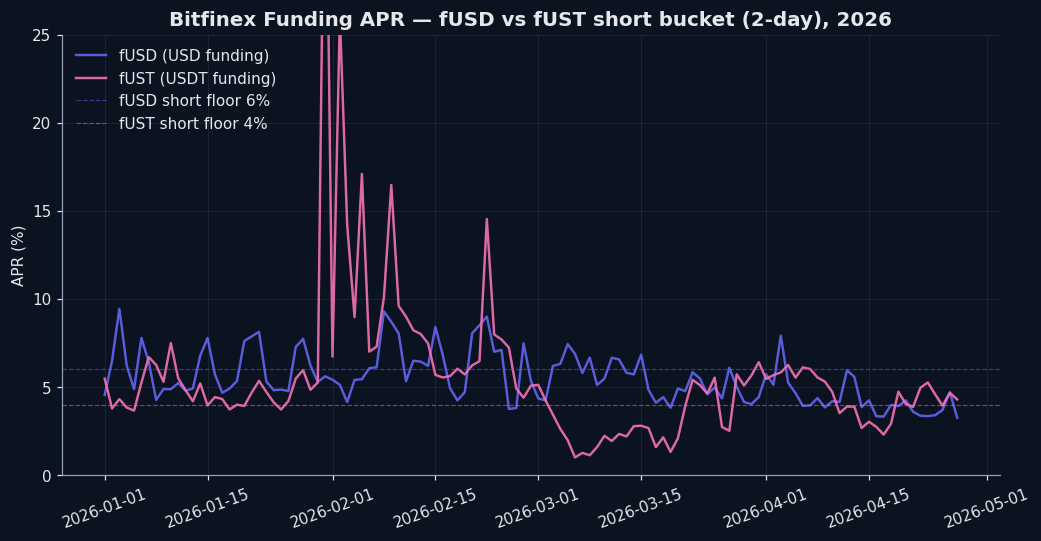
If you’ve ever placed a Bitfinex Funding offer, you’ve seen the “FRR” toggle next to “Flash Return Rate” — click it and you don’t have to set the rate yourself.
But how is FRR actually calculated? Why do most experienced lenders tell you to “avoid FRR”? And when is FRR actually better than manual limit orders? This post answers with real 2026 data.
TL;DR
- FRR = Bitfinex’s auto-computed “fair market rate”, updated hourly
- FRR offers fill quickly, but typically 0.5-1pp lower than limit orders (borrowers pay a premium for rate certainty)
- Use FRR: capital < $1K, calm market, don’t care about peak optimization
- Use limit orders: capital > $5K, volatile market, want to capture spikes
- If you use an automated bot, it picks for you — you don’t have to learn
What FRR Is
FRR = Flash Return Rate. Bitfinex computes this value hourly, weighted-averaged from recent funding fills.
Think of FRR as “Bitfinex’s view of fair market price” — it tracks supply and demand.
When you place a funding offer, you have two modes:
- Limit order: you specify the rate, e.g. “8% APR, 7-day period”. Only fills if a borrower will pay that.
- FRR offer: rate set to “current FRR”. Each hourly FRR update changes your live offer’s rate too.
How FRR Is Calculated
Bitfinex doesn’t publish the exact formula, but based on API observation and community reverse-engineering, FRR is a weighted average of all funding fills in the past 60 minutes, weighted by notional × period.
Practical FRR characteristics:
- Lagging: when rates move sharply, FRR takes 1-2 hours to catch up
- Smoothed: short spikes get averaged out, don’t directly lift FRR
- Conservatively low: borrowers fearing rate spikes bid below their fixed-rate equivalent
Observation: from Bitfinex’s public funding stats, FRR offers’ average fill rate typically runs 0.5-1pp below same-window fixed limit orders. The exact gap varies by symbol and regime; large-capital users see wider gaps because limit orders can lock in spike highs that FRR misses.
Why Borrowers Like FRR
From the borrower (margin trader) side:
- Fixed-rate limit order → cry when rates rise, win when rates fall
- FRR offer → rate tracks market hourly, no lock-in risk
Borrowers will pay a small premium (0.5-1pp) for this certainty. So FRR demand is durable, but the fill rate is suppressed.
From the Lender (You) Side: Should You Use FRR?
When NOT to use FRR
1. You have meaningful capital ($5K+) Bigger capital means you can afford to wait for better prices. Limit orders take longer to fill, but when they do they pay 0.5-1pp more. $10K × 1pp = $100/year — material.
2. Rates are climbing FRR reflects the past 1-2 hours of fills, so during a spike your FRR offer keeps filling at stale low rates. Manual limit orders can lock in the spike high.
3. You’re validating a strategy FRR is the market average, not your strategy. To know if “8% floor is right”, you need to see your 8% limit-order fill rate, not let FRR fill at whatever.
When FRR Is Fine
1. Tiny capital ($500-$1000) At small scale, fill rate matters more than rate optimization. FRR almost always fills; a limit order might sit in the book unmatched for 3 days.
2. Long-running flat markets When rates aren’t moving, FRR ≈ limit-order fills. Use FRR and save the effort.
3. Genuine apathy Some users don’t want to learn or watch the book. FRR is a reasonable “no-thought” default.
Typical Trade-off
From Bitfinex’s public funding book + stats observation + first-principles reasoning:
| Metric | FRR offer | Limit order (high floor) |
|---|---|---|
| Avg time-to-fill | Usually < 1 hour | Hours to days (depends on floor) |
| Fill rate | At market FRR | Limit or no fill |
| 48-hour fill probability | High (> 90%) | Moderate (depends on floor) |
| Best-fit capital | Any | $5K+ |
Exact numbers depend on your wallet — a 7-day trial gives you real observed fill behavior for your portfolio.
Core trade-off stays: FRR is fast but cheap; limit orders are slow but more profitable.
Advanced: FRR + Limit Order Hybrid
A common pro strategy is:
- 30% capital on FRR (steady fill flow as a base)
- 70% capital on a high-floor limit order (waits for spikes)
This guarantees some capital is always earning FRR while still leaving room for spike capture.
Yieldsforge’s 4-bucket strategy is essentially the next evolution of this — using period diversification instead of FRR/limit split, with better results.
Decision Tree
Your funding capital?
├─ < $500  → Bitfinex's $150 minimum is technically met but ROI is poor. Wait until $500.
├─ $500-3K → FRR is fine. Manual management isn't worth the time.
├─ $3K-10K → Limit orders + occasional FRR (70/30 split)
└─ $10K+   → Full limit orders, or let a bot run [multi-bucket strategy](/en/blog/multi-bucket-vs-spike-chasing)
Related Reading
- How Bitfinex Funding APR Actually Works — the broader mechanic primer
- Choosing Funding Period — Short vs Long Trade-offs
- Bitfinex Funding Bot Comparison 2026
- Why Bitfinex Funding Beats DeFi Yields — the hub post
Skip the Manual Phase
Yieldsforge handles FRR vs limit selection automatically, 5.5-year walk-forward backtested, $60/yr flat, zero performance fee. 7-day free trial.
Disclosure: I’m the developer of Yieldsforge. Empirical data from Bitfinex public funding stats API, 2026-01 to 2026-04. Not investment advice.