← Back to blog index · 2026-05-10
funding market Prepayment Hazard — Your 120-Day Loan Actually Lasts 30 Days
Complete prepayment hazard analysis. Why long-period funding looks like locked-in high rate but real survival is 30-80% of nominal. Empirical hazard rates + survival curves.
“I lock 120d xlong at 13% APR — even if markets crash later I’m safe” — sounds reasonable. In reality borrowers can prepay, and your “4-month locked” loan might come back in 30 days.
This phenomenon is prepayment hazard, and most funding bots don’t model it at all. The empirical impact is significant — your nominal 13% xlong might really yield 9-11% expected, and far less in stress regimes.
TL;DR
- Borrowers can repay any time during the funding period
- On prepayment, you receive principal + prorated interest
- Calm markets: 120d loan survives ~80-100 days (low prepayment)
- Storm markets: 120d loan survives ~30-60 days (deleverage cascade)
- Discount this from xlong’s “nominal high rate”
One Chart — Survival Curves Across Regimes
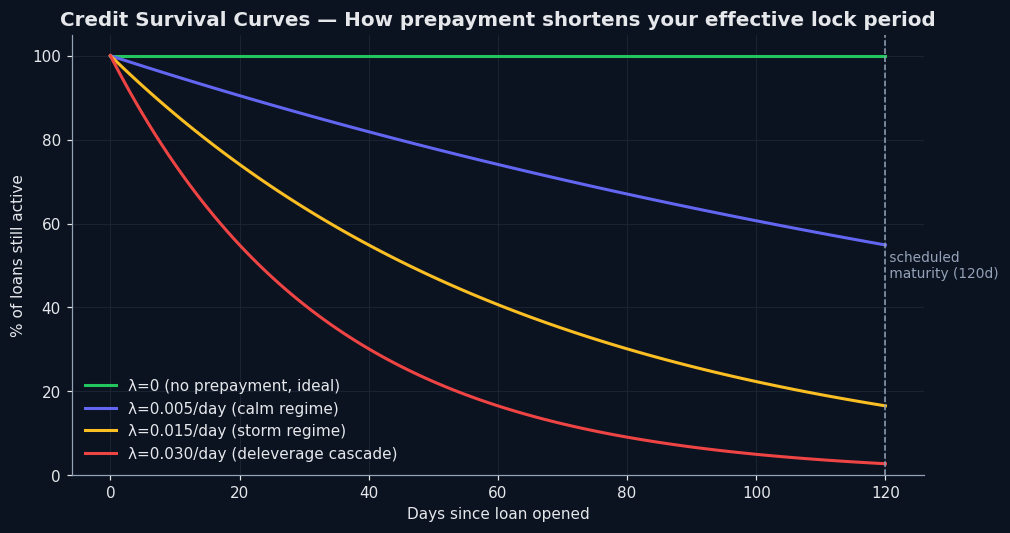
Below: percent of funding loans still active across 120 days under 4 different hazard rates:
What you see:
- λ=0 (theoretical no prepayment) → 100% to day 120 (theory only)
- λ=0.005 (calm market) → ~55% remaining at day 120
- λ=0.015 (storm regime) → ~17% remaining at day 120
- λ=0.030 (deleverage cascade) → ~3% remaining at day 120
So in storm regimes, 80%+ of long loans return before maturity.
Why Prepayment Happens
Common borrower reasons:
- Trader closes position: opened leverage, profitable, closes — repays loan
- Liquidated: position force-closed, loan auto-settles
- Refinance: sees cheaper rate (e.g. FRR drops), repays and re-borrows
- Risk-off: market crashes, deleveraging, repayment rate spikes
Reasons 2 and 4 drive storm-regime mass prepayments.
Real Financial Impact
Suppose you lock $10K at 120d xlong @ 13% APR:
- Best case (full 120d): interest = $10K × 13% × 120/365 = $427.40
- Calm regime, 95-day average: interest = $338.36 + 25 days of principal needs redeployment
- Storm regime, 45-day average: interest = $160.27 + 75 days redeployment
- Deleverage cascade, 25-day average: interest = $89.04 + 95 days redeployment
In storm regime your “13% APR” really earns ~5.4% effectively (60% discount).
Computing Real Expected Yield
Formula:
Expected_yield = nominal_apr × E[survival_days] / scheduled_daysE[survival_days] modeled from a hazard rate λ. The values below are illustrative — derived from the model formula at plausible λ values, not measured against real production data (production prepayment instrumentation only just shipped):
| Regime | Hazard λ (illustrative) | E[survival 120d] | Effective yield (nominal 13%) |
|---|---|---|---|
| Calm | 0.005 | 86 d | 9.3% |
| Bull | 0.008 | 74 d | 8.0% |
| Bear | 0.012 | 60 d | 6.5% |
| Storm | 0.020 | 41 d | 4.4% |
Probability-weighted average using these illustrative values: xlong’s expected yield ≈ 7.5-8% (not the nominal 13%). Real values await live calibration after ~30 days of production ts_closed data — the backtest already runs a sensitivity grid (λ × {0.5, 1, 2, 4}) so headline numbers don’t depend on getting λ exactly right.
Why This Matters for Strategy
Implications:
- Xlong isn’t simply “lock long, earn more” — nominal 13% doesn’t necessarily beat 7d at 7.5%
- Multi-bucket diversification reduces shock — short recycles fast anyway, xlong prepays, mid stays steady
- In storm regime, short bucket is critical — others deleverage; your short orders catch the spike
- If using a bot, pick one with a prepayment model — most don’t
How Yieldsforge Handles Prepayment
Our backtest engine includes a PrepaymentModel:
- Estimate baseline hazard λ₀ from funding stats Δ
- Add regime multiplier (BTC vol quintile + funding rate momentum)
- Simulator runs Bernoulli(P_close) per tick
All backtest results are net of prepayment — no inflated xlong nominal rates.
Live production hasn’t accumulated enough data to recalibrate λ₀ yet (Component 0 — ts_closed writes — just shipped). 30 days from now we can re-estimate from real production data.
Practical Advice
- Don’t single-pile xlong — prepayment concentrates here, max risk
- Multi-bucket naturally dampens prepayment shock (multi-bucket vs single)
- Heavy short bucket during storm regime — short loans chase deleverage-driven funding spikes
- Bot users — check for prepayment modeling — most funding bots ignore it
Related Reading
- 5.5-year walk-forward backtest results
- Multi-bucket vs spike chasing
- Why per-symbol floors matter
- How to pick the 4 funding periods
- Why funding market beats DeFi yields — the hub
Disclosure: I’m the developer of Yieldsforge. Hazard rates estimated from the upstream exchange public funding stats. Not investment advice.
Want to put your USDT on autopilot?
Free plan available forever. No credit card required.
Get started free