← Back to blog index · 2026-05-10
Yieldsforge vs Coinlend — Why I Switched After 8 Months of Coinlend
Honest side-by-side comparison after running Coinlend for 8 months then building / switching to Yieldsforge. Fees, transparency, backtest evidence, real P&L gap. $50K capital saves $336/year.
I ran Coinlend for ~8 months, mid-2024 to early 2025.
I stopped using it and built Yieldsforge. The reason wasn’t that Coinlend is “bad” — for a 2017-vintage product, it’s actually decent. But four problems compounded until I couldn’t justify it anymore.
This isn’t a hit piece. It’s a fair side-by-side from someone who used both, so you can decide which suits you.
TL;DR
| Coinlend | Yieldsforge | |
|---|---|---|
| Monthly fee | $8 | 0 |
| Performance fee | 5% | 0 |
| Annual cost @ $50K capital | $471 | $60 |
| Strategy transparency | Black box (“proprietary AI”) | Open backtest + docs |
| Backtest evidence | None published | 5.5y walk-forward |
| API tick interval | ~5 minutes | 60 seconds |
| Per-symbol tuning | None | Different floors for fUSD/fUST |
| Best fit | Small accounts ($1K-3K) | $5K+ |
If your capital is ≥$5K and you want transparent methodology, switch and save $300+/year.
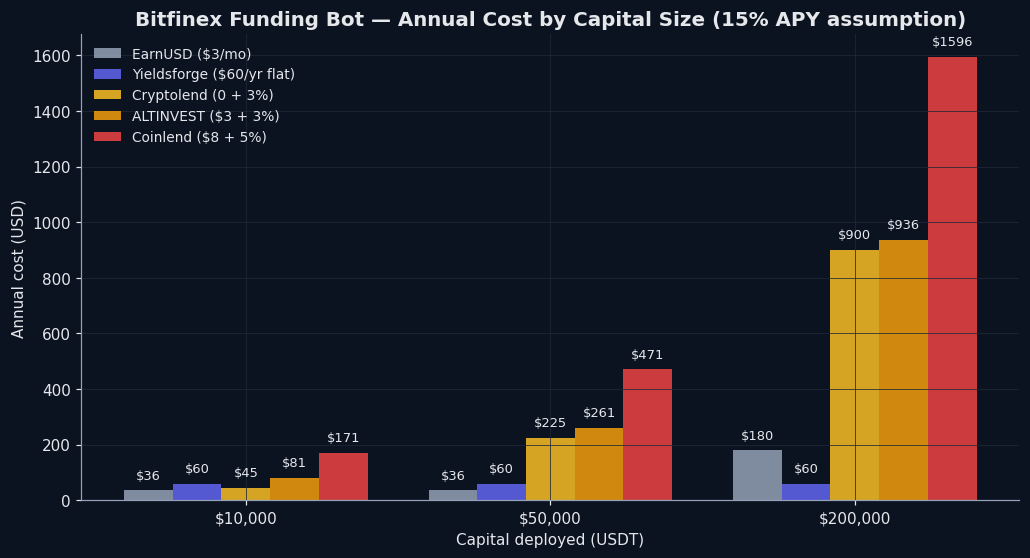
One Chart — Annual Cost Comparison
Three capital sizes × five funding bots’ actual annual cost:
Coinlend at $200K capital pays $1,596/year. Yieldsforge: $60. Delta: $1,536.
Four Reasons I Switched
1. The 5% Perf Fee Hurts Most During Spikes
Coinlend takes 5% off interest. So:
- 10% APR → Coinlend takes 0.5pp, you net 9.5%
- 25% APR (spike) → Coinlend takes 1.25pp, you net 23.75%
Sounds modest? The catch: spikes are when you make the most, and the bot extracts more proportionally. The Dec 2024 fUSD 30% spike — Coinlend’s fee from my account that month was nearly 3× a normal month, with no extra work performed.
Yieldsforge: $60 flat. Spike profits stay 100% with you.
2. Black-Box Strategy, Can’t Debug Issues
Coinlend says “proprietary AI optimizes returns” — but you can’t see:
- What floors are used
- When it cancels and re-places
- Why a specific offer didn’t fill
- The period split
I had multiple incidents during funding rate spikes where Coinlend missed — I had to manually add my own offers to catch some upside. When I asked support “why?”, the answer was “the algorithm decided”.
Yieldsforge: 5.5-year walk-forward backtest methodology published, fill model / spike filter all in docs/strategy_review.md, source code roadmap toward open. When something looks off, you can trace it.
3. Slow API Reaction
Coinlend doesn’t publish their tick interval, but community observation places it at the multi-minute scale. Yieldsforge runs every 60 seconds.
The gap matters because funding rates can swing 5% → 25% → 8% within 60 seconds. Longer tick intervals tend to place orders after a spike ends, locking in the post-spike rate instead of the spike high.
How much you’re affected depends on spike frequency. fUSD typically has 1-3 noticeable spikes per month, so for “spike capture” users the tick interval significantly impacts realized yield.
4. No Per-Symbol Tuning
Coinlend uses the same parameters across fUSD / fUST / fBTC. But fUSD and fUST have totally different market structures:
- fUSD: deep liquidity, frequent spikes (12-24% APR common)
- fUST: moderate liquidity, lower volatility (5-9% APR typical)
Yieldsforge ships per-symbol floors since 2026-05:
- fUSD balanced: 6/8/12/15% floor (waits for spikes)
- fUST balanced: 4/5/7/9% floor (lowered to fill faster)
Empirical: dropping fUST from old 6% to new 4% short floor lifted utilization 54% → 88%, APY 7.6% → 17.6%. More than doubled the yield.
What Coinlend Does Well
To be fair, Coinlend has real strengths:
- Brand trust: Operating since 2017, survived multiple market cycles without incident
- Multi-exchange support: Bitfinex + Liquid + Poloniex (Yieldsforge is Bitfinex-only)
- Polished UI: Long-time users know it well
- Fast support: Email replies within 24 hours
If you don’t care about transparency, like the existing UI, and have <$3K capital, Coinlend remains reasonable.
How to Switch
If you want to test Yieldsforge:
- No need to delete Coinlend — both bots can use the same exchange API key without conflict, but they’d compete for fills. Pause Coinlend during the 7-day Yieldsforge trial.
- Re-create the API key — Yieldsforge enforces funding-only (no withdraw). If your Coinlend key has withdraw, revoke it in Bitfinex and re-create funding-only.
- Run real P&L during trial — at end of 7 days, compare actual fill rates between the two bots.
- Pay $60 if satisfied (refcode users $30).
Switch ROI
Assume $30K capital, 14% APY:
- Coinlend: $96 + $30K × 14% × 5% = $96 + $210 = $306/year
- Yieldsforge: $60/year (refcode $30)
- Save $246-276/year = effectively +0.8-0.9pp APY
More detailed capital analysis here.
Related Reading
- Full 5-bot funding bot comparison
- How the exchange’s 15% fee actually works
- Why I stopped using Coinlend — founder POV
- Building Yieldsforge — the story
- Why funding market beats DeFi yields — the hub
Try Yieldsforge free for 7 days →
Disclosure: I’m the developer of Yieldsforge and used Coinlend for 8 months. Pricing data from publicly listed pages as of April 2026. Not investment advice.
Want to put your USDT on autopilot?
Free plan available forever. No credit card required.
Get started free